The board
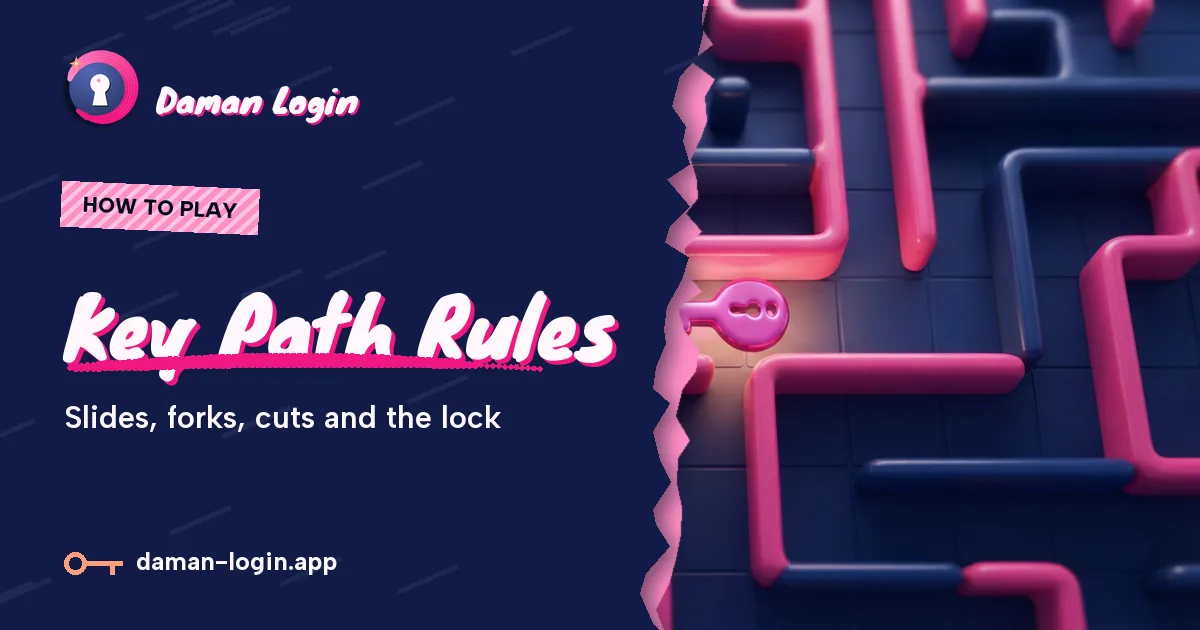
Each level is a square grid of rooms with walls between some of them. The walls form a perfect maze: one route, and only one, joins any two rooms. Your key starts in one of the four corners. The lock sits in the room farthest from it, always at a dead end.
How the key moves
Choose up, down, left or right. The key slides in that direction and keeps going through straight corridors. It stops as soon as one of two things happens:
- a wall is directly in front of it, which happens at bends and dead ends, or
- it enters a fork, a room with three or four ways out.
If there is a wall right next to the key in the direction you chose, nothing moves and the key gives a little bump.
Key cuts
Peach sparkles on the floor are key cuts. The key picks one up by sliding over it or stopping on it. Each cut is worth 50 points and adds 3 seconds to the clock. Small mazes have two, mazes from 7×7 have three. Some lie on the route to the lock; others are worth a short detour when time allows.
The clock and spare keys
The clock is set from the maze: longer routes and more turns get more time. It starts on your first slide of the level. When it empties, a spare key is used and the same maze starts again from the corner with a full clock. A run begins with 2 spare keys; every third lock opened gives one back, up to 3. If the clock empties with no spare left, the run is over.
Scoring
| Event | Points |
|---|---|
| Key cut picked up | 50 |
| Lock opened | 100 × level number |
| Time left at the lock | 10 per whole second |
| Clean route (slides ≤ par) | 150 |
Par is the fewest slides that can reach the lock, shown above the board. Matching it is the hardest part of the game and the best way to a big score.
How the mazes grow
| Levels | Board | Key cuts |
|---|---|---|
| 1–2 | 5×5 | 2 |
| 3–4 | 6×6 | 2 |
| 5–6 | 7×7 | 3 |
| 7–8 | 8×8 | 3 |
| 9 and up | 9×9 | 3 |
From level 9 the board stays at 9×9 and the clock is trimmed by a few per cent each level, down to about three quarters of its starting length.
Controls
- Phone: swipe anywhere on the board, or tap a room in line with the key.
- Pad: the four arrow buttons under the board.
- Keyboard: arrow keys or W, A, S, D.
- Pause: the pause button stops the clock. Switching tabs pauses it too.
Three habits of good runs
- Trace the route backwards from the lock before your first slide. Dead ends near the lock are where wrong turns hide.
- Count the forks on your route. Every fork is a forced stop, so it tells you roughly what par will be.
- Fetch a cut only if it sits one or two slides off the route. Three seconds rarely pay for a long detour.
Your locks and best score are kept on your card. Make one before a long session so nothing is lost.